-
- Products
- Indoor Household Cords
- Appliance Cords
- General Purpose Short-Length Cords
- General Purpose Extension Cords
- Landscape & Decorating Cords
- Bright Color Extension Cords
- Oil-Resistant Extension Cords
- Cold-Flex Extension Cords
- VividFlex Power Cords
- EXTREME All-Weather Cords
- Cord Management
- Task Lights
- Adapters & GFCI Devices
- Where to Buy
- About
- Careers
- Glossary
- Catalog


What Is a Corrugated Suction Hose Used For?
A Corrugated Suction Hose transfers liquids, slurries, and some lightweight solids under suction or low-pressure discharge. Its corrugated wall bends around pumps, tanks, and uneven ground. The internal helix helps resist collapse when negative pressure develops. That flexibility explains its popularity in agriculture, construction, drainage, and industrial fluid handling.
Grand View Research’s Industrial Hose Market report identifies agriculture, construction, and manufacturing as major demand sectors. FAO’s 2023 State of Food and Agriculture also highlights irrigation efficiency as a continuing global priority. These trends increase the need for dependable hoses around pumps and water systems. A farm operator may connect this hose to a transfer pump, moving water from a storage pond. A contractor may use it for muddy drainage after heavy rain. In a factory, it can handle compatible chemicals or process liquids, subject to material approval.
Application matters greatly. The hose must match the fluid, temperature, suction pressure, bend radius, and connection size. A hose that survives water may fail quickly with abrasive slurry or oil. Small cracks can appear between corrugations. They are easy to miss.
That assumption deserves challenge.
The U.S. Occupational Safety and Health Administration stresses proper inspection and maintenance of flexible hoses and couplings. Industry standards, including ISO 1307, support consistent hose dimensions and testing practices. However, standards do not replace site-specific engineering. Always verify the manufacturer’s chemical-resistance chart and vacuum rating. Selecting by appearance alone is an avoidable mistake. This guide explains what a Corrugated Suction Hose is used for, where it performs well, and where another hose design may be safer.
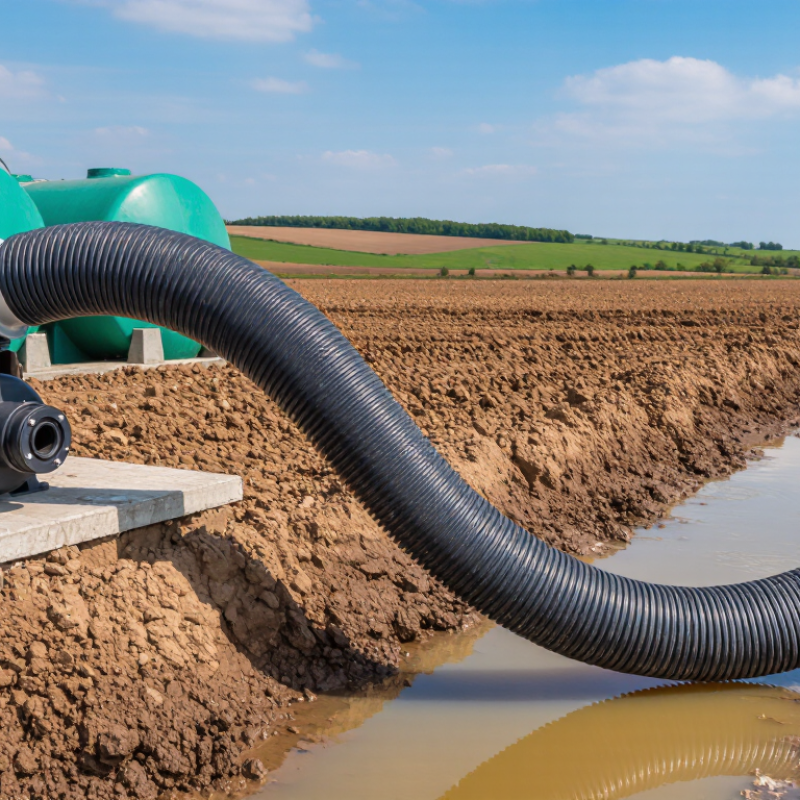
Table of Contents [Hide]
What Is a Corrugated Suction Hose?
A corrugated suction hose is a flexible tube designed to move liquids, slurries, or light bulk materials under suction. Its outer wall has repeating ridges, called corrugations. These ridges help the hose bend around pumps, tanks, and uneven ground without collapsing easily. Many suction hoses also contain a rigid spiral reinforcement. This support helps the hose resist vacuum pressure during operation.
The hose body may use PVC, rubber, polyurethane, or another compatible material. The correct choice depends on the fluid, temperature, abrasion level, and working pressure. For example, a construction site may use it to draw muddy water from a pit. An agricultural system may transfer irrigation water from a storage tank. Some versions handle abrasive particles, but not every corrugated hose can do so safely.
In practical use, the hose must match the pump’s suction requirements. A narrow hose can reduce flow and increase strain on the pump. Excessive bending can also restrict liquid movement. Keep it short when possible. Inspect the ridges, fittings, and reinforcement before each shift. Cracks may appear inside first, where they are easy to miss. A hose can look strong and still fail under vacuum. That is an important lesson from routine maintenance. Compatibility charts should guide chemical service, because visual inspection alone is not enough.