
-
- Products
- Indoor Household Cords
- Appliance Cords
- General Purpose Short-Length Cords
- General Purpose Extension Cords
- Landscape & Decorating Cords
- Bright Color Extension Cords
- Oil-Resistant Extension Cords
- Cold-Flex Extension Cords
- VividFlex Power Cords
- EXTREME All-Weather Cords
- Cord Management
- Task Lights
- Adapters & GFCI Devices
- Where to Buy
- About
- Careers
- Glossary
- Catalog


What Is a 3D Sock Knitting Machine?
A 3D Sock Knitting Machine is a computerized knitting system designed to shape yarn into a sock, rather than produce a flat fabric panel that must be extensively sewn. Depending on its configuration, it can form the leg, heel, foot, and toe in a programmed sequence. Needles move around a cylinder, while yarn feeders supply different yarns or colors. The result is a shaped garment made with fewer assembly steps. “3D” describes the forming process; it does not guarantee that every sock is completely seamless.
Industry reports help explain why this equipment attracts attention, though they do not measure this machine category alone. Textile Exchange’s Materials Market Report 2024 estimates that global fiber production reached 124 million tonnes in 2023. That scale puts pressure on manufacturers to understand material use, production efficiency, and waste—not just machine speed. ITMF’s International Textile Machinery Shipment Statistics tracks machinery shipments across textile sectors, including knitting equipment. Its scope is broader than 3D sock production, so it should not be treated as a direct market-size estimate. That distinction matters.
For buyers, the practical questions are concrete: What sock styles can the machine make? How quickly can operators change yarn or size settings? What skills are needed to maintain it? A demo sock can look perfect, yet ordinary production may reveal tension issues or downtime. That is easy to overlook. This guide explains how a 3D Sock Knitting Machine works, which components shape its output, and what to check before choosing one. The term itself can sound more precise than the real-world differences between models.
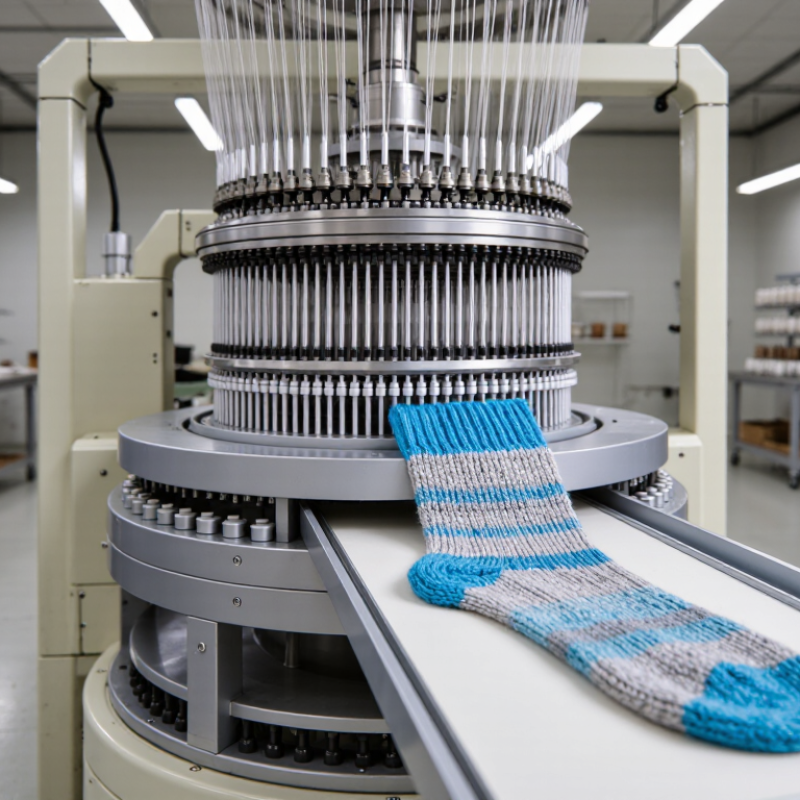
Table of Contents [Hide]
What a 3D Sock Knitting Machine Is
A 3D sock knitting machine forms a sock directly on a circular knitting system. Needles arranged around a cylinder catch yarn and create interlocking loops. Those loops build the leg and foot as a connected textile. Not a printer. Here, “3D” refers to the sock’s volume and shaping, rather than a flat piece later sewn into a tube.
On many machines, needle selection and movement help shape the heel and toe. The machine can also vary stitch structure, making areas feel tighter or more open. For example, the fabric over the instep may be lighter, while the heel needs extra durability. Exact capabilities differ by machine and setup, so the term does not guarantee a particular fit or feature. A technician may adjust yarn tension and stitch settings after checking a sample sock. Small changes matter: a loop that looks even on the cylinder can feel rough against a toe. The label “3D” is useful, but not perfectly precise. The knitted structure itself explains more.