
-
- Products
- Indoor Household Cords
- Appliance Cords
- General Purpose Short-Length Cords
- General Purpose Extension Cords
- Landscape & Decorating Cords
- Bright Color Extension Cords
- Oil-Resistant Extension Cords
- Cold-Flex Extension Cords
- VividFlex Power Cords
- EXTREME All-Weather Cords
- Cord Management
- Task Lights
- Adapters & GFCI Devices
- Where to Buy
- About
- Careers
- Glossary
- Catalog


Top Type 1 Type 2 Charging Cables for Global Buyers
Choosing the right Type 1 Type 2 Charging Cable can affect charging speed, safety, and daily convenience. For global buyers, the connector shape is only one part of the decision. Type 1 cables commonly serve vehicles with SAE J1772 inlets, especially in North America and Japan. Type 2 cables are widely used with IEC 62196-2 systems across Europe and many other markets. These standards are not interchangeable by appearance alone.
Small details matter. A cable rated for 32 amps may support different charging performance than a 16-amp model. Vehicle limits, wallbox output, phase configuration, and local electrical conditions must match. Buyers should also check cable length, conductor quality, insulation strength, IP protection, heat resistance, and certification documents. A five-meter cable may reach a driveway socket easily, but it can become heavy in a small trunk. An overly short cable can be frustrating beside crowded charging bays.
Reliable suppliers should provide clear technical data, traceable testing, and practical warranty support. Look for firm connector locking, clean contact pins, flexible insulation, and strain relief that does not crack after repeated bending. Never assume a higher current rating means faster charging. The vehicle may set the limit.
No buying guide is flawless. Regional terminology can vary, and product listings sometimes simplify important specifications. This guide therefore compares cable types through compatibility, durability, charging capacity, and real-world handling. It aims to help fleet managers, distributors, installers, and private drivers make careful decisions with fewer costly surprises.
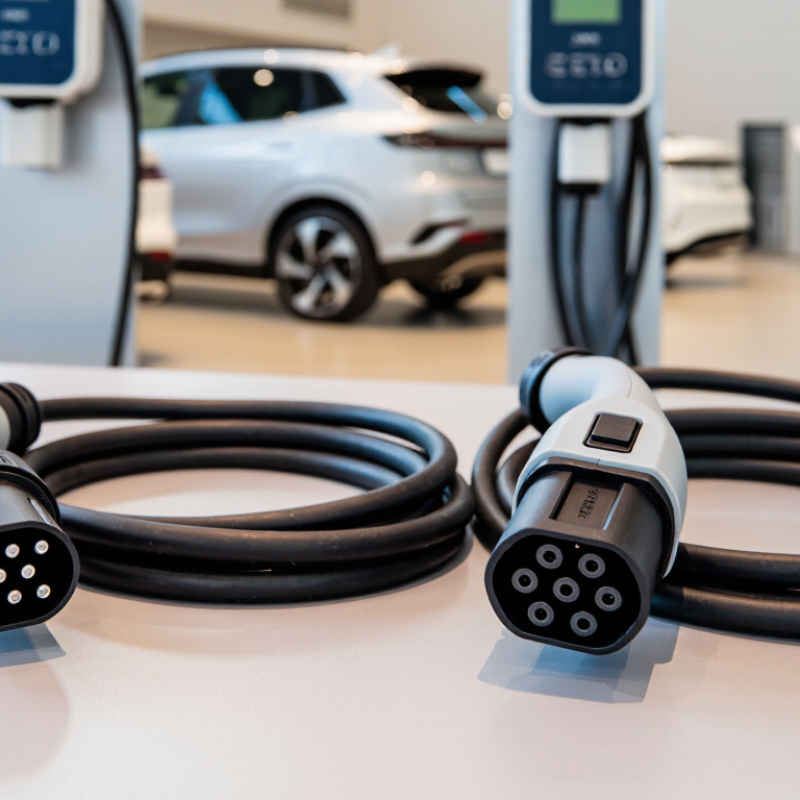
Table of Contents [Hide]
Understanding Type 1 and Type 2 Charging Cable Standards
Top Type 1 Type 2 Charging Cables for Global Buyers
Understanding the charging standard matters before choosing a cable. Type 1, also called SAE J1772, usually supports single-phase AC charging. It is common in North America and parts of Asia. Type 2 follows IEC 62196-2 and is widely used across Europe and other markets. It can support single-phase or three-phase AC power, depending on the vehicle and charger.
Look closely at the connector shape and pin arrangement. Type 1 has five main contacts, while Type 2 commonly has seven. The extra contacts support broader control and power configurations. A cable marked 32 A may still charge at a lower rate. The vehicle, charger, and electrical installation must work together. A higher rating does not create extra charging capacity.
Cable length also affects daily use. A five-meter cable can reach a driveway socket more easily, but it weighs more. Check insulation, strain relief, temperature resistance, and weather protection. Technicians often inspect the connector after repeated outdoor use. Heat marks or loose pins deserve attention. A clean fit is not proof of electrical safety. That assumption is easy to make, and sometimes wrong. Buyers should verify the standard, current rating, phase support, and local socket compatibility before ordering. Small specification errors can turn a convenient cable into an expensive mismatch.