-
- Products
- Indoor Household Cords
- Appliance Cords
- General Purpose Short-Length Cords
- General Purpose Extension Cords
- Landscape & Decorating Cords
- Bright Color Extension Cords
- Oil-Resistant Extension Cords
- Cold-Flex Extension Cords
- VividFlex Power Cords
- EXTREME All-Weather Cords
- Cord Management
- Task Lights
- Adapters & GFCI Devices
- Where to Buy
- About
- Careers
- Glossary
- Catalog


Top 10 Types of Tarpaulin Sheets for Global Buyers?
Tarpaulin Sheets protect cargo, machinery, crops, vehicles, and outdoor workspaces from rain, sunlight, dust, and abrasion. Yet “tarpaulin” describes many constructions, not one universal product. Polyethylene, PVC-coated fabric, canvas, mesh, fire-retardant, and insulated sheets each serve different operating conditions. A blue woven cover may suit short-term storage, while a heavy PVC sheet performs better beside a busy loading dock.
Market reports indicate sustained demand for protective textiles and coated fabrics across construction, agriculture, transport, and logistics. Grand View Research has identified construction and industrial applications as important growth areas within technical textiles. Allied Market Research has also reported expanding demand for protective and coated fabric solutions. However, published market figures vary because researchers define tarpaulins differently. That uncertainty deserves attention.
This guide compares the top 10 types of Tarpaulin Sheets for global buyers. It focuses on practical selection, not attractive catalog language. Key factors include fabric weight, coating thickness, tensile strength, tear resistance, UV stability, waterproof performance, temperature tolerance, and eyelet durability. Product specifications should be verified through test reports, sampling, and documented quality controls. A waterproof claim alone is not enough. Neither is a high GSM figure.
Small details matter. A reinforced corner can prevent failure during strong winds. Correct eyelet spacing can reduce stress around tied edges. Factory experience also reveals weaknesses that laboratory figures may miss, especially during folding, transport, and repeated installation. No product is perfect. Buyers should balance service life, budget, climate, and intended use before choosing a sheet. That is where informed comparison becomes valuable.
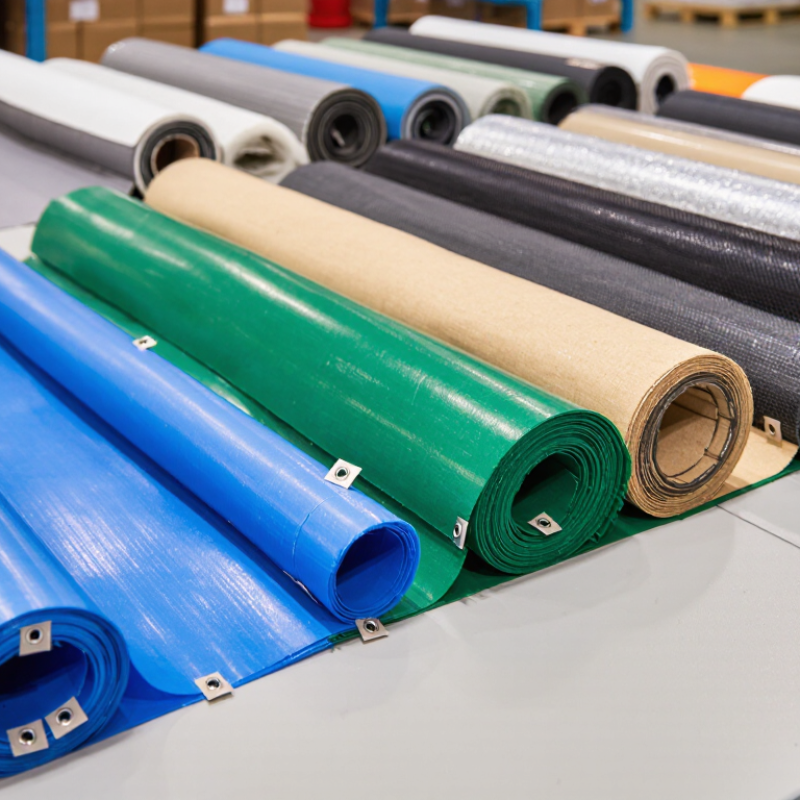
Table of Contents [Hide]
Tarpaulin Sheets: Definition, Structure, and Core Functions
Tarpaulin Sheets: Definition, Structure, and Core Functions
A tarpaulin sheet is a flexible, coated, or laminated textile designed to resist water, sunlight, dust, and abrasion. Common constructions use woven polyethylene, polypropylene, PVC-coated polyester, or canvas. The base fabric provides tensile strength, while the coating limits moisture penetration.
That distinction matters. A thick sheet may still fail if its seams, eyelets, or edges are weak.
Industry reports estimate the global tarpaulin market at several billion U.S. dollars annually, although figures differ by product scope and regional coverage. One 2024 market analysis projects continued growth through 2030, supported by construction, agriculture, transport, and emergency shelter demand. These figures are useful, but not perfect. Some reports include temporary structures, while others count only finished sheets.
In practical use, structure determines performance. A tightly woven fabric suits repeated folding and cargo covering. A laminated polyethylene sheet offers low weight and economical weather protection. PVC-coated polyester usually provides stronger tear resistance and longer outdoor service.
Look for denier, fabric weight, coating thickness, seam method, UV treatment, and reinforced corner patches. A sheet covering a truck bed needs different engineering from one protecting harvested grain.
Field experience also exposes a common mistake: buyers compare grams per square meter, then overlook stitch quality and grommet spacing. That decision can fail in wind.