
-
- Products
- Indoor Household Cords
- Appliance Cords
- General Purpose Short-Length Cords
- General Purpose Extension Cords
- Landscape & Decorating Cords
- Bright Color Extension Cords
- Oil-Resistant Extension Cords
- Cold-Flex Extension Cords
- VividFlex Power Cords
- EXTREME All-Weather Cords
- Cord Management
- Task Lights
- Adapters & GFCI Devices
- Where to Buy
- About
- Careers
- Glossary
- Catalog


China Top Portable Power Station Suppliers?
Choosing among China’s top Portable Power Station suppliers requires more than comparing prices or reading polished product pages. A reliable supplier should demonstrate manufacturing experience, stable quality control, and clear technical documentation. Buyers should examine battery chemistry, rated capacity, inverter output, charging speed, noise levels, and protection systems. These details matter when a unit powers a campsite refrigerator, camera equipment, or emergency lighting.
A practical evaluation begins with factory evidence. Request recent test reports, product samples, warranty terms, and production photographs. Check whether the supplier explains capacity testing and provides realistic runtime estimates. Certifications such as CE, FCC, UN38.3, and IEC-related compliance may support market access, but documents should be verified for the specific model. Do not assume one certificate covers every product.
Supplier communication also reveals operational maturity. Experienced exporters usually answer technical questions directly and explain limitations without exaggeration. They should discuss cell sourcing, battery management systems, firmware updates, packaging, and after-sales support. Sample testing is essential. Small differences in charging temperature, fan noise, or display accuracy can become costly after a large order.
The “top” supplier is not always the largest factory. Sometimes, a smaller manufacturer offers faster engineering feedback and better customization. That assumption can fail, however, if its quality system is weak. Buyers should compare several suppliers, inspect production consistency, and record performance under realistic loads. A trustworthy partnership develops through evidence, not impressive promises.
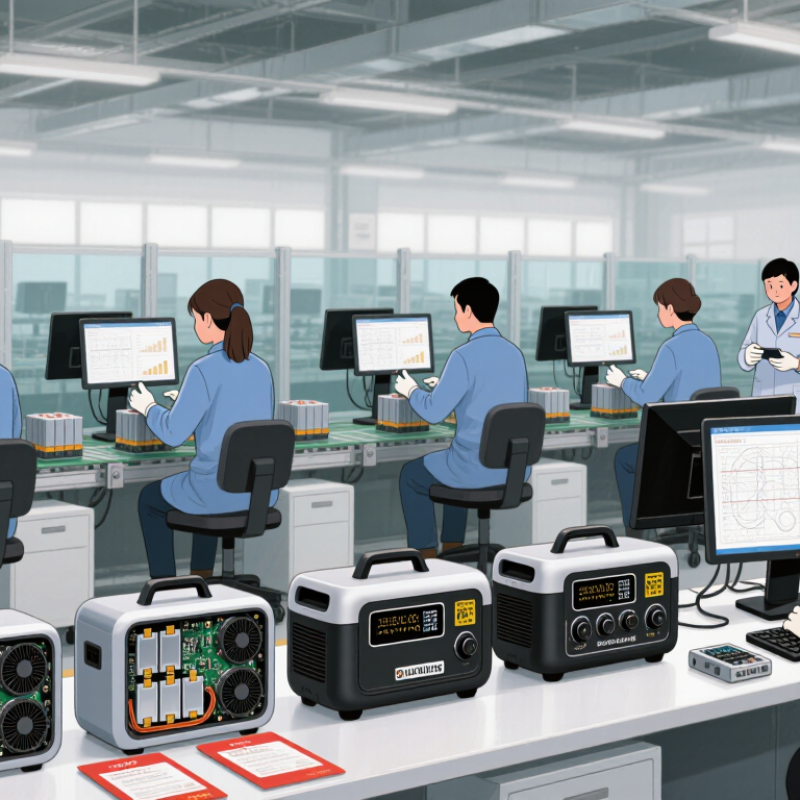
Table of Contents [Hide]
What Makes a Portable Power Station Supplier Top-Ranked in China
What Makes a Portable Power Station Supplier Top-Ranked in China
A top-ranked supplier offers more than a low factory quotation. Grand View Research reported that the global portable power station market reached about USD 545 million in 2023. It also projects strong growth through 2030. This demand raises the value of stable engineering and dependable production.
A capable supplier should provide clear battery test records, traceable cells, and inspection reports for every shipment. Ask for protection data covering overcharge, overheating, short circuits, and abnormal temperature changes. IEC 62133-2 and UN 38.3 testing are important reference points for lithium battery products. Local compliance evidence also matters, including applicable Chinese GB standards.
Look closely at the factory process. Can workers explain why a cooling fan starts at a certain temperature? Can the supplier show load-testing records from real production units? A useful audit should include sample testing, not only a polished showroom. Small details expose quality gaps. Loose handles, uneven screens, or unstable inverter output deserve attention.
China Energy Storage Alliance reports continued expansion in battery manufacturing capacity, but capacity alone does not guarantee consistency. Some suppliers still depend heavily on subcontractors. That can complicate traceability and after-sales service. A stronger partner assigns technical staff, documents firmware changes, and keeps replacement parts available. Response time should be tested before purchase. Send a difficult technical question. The answer may reveal more than a sales presentation. I would not treat any single certificate as final proof. Field reliability remains harder to measure.