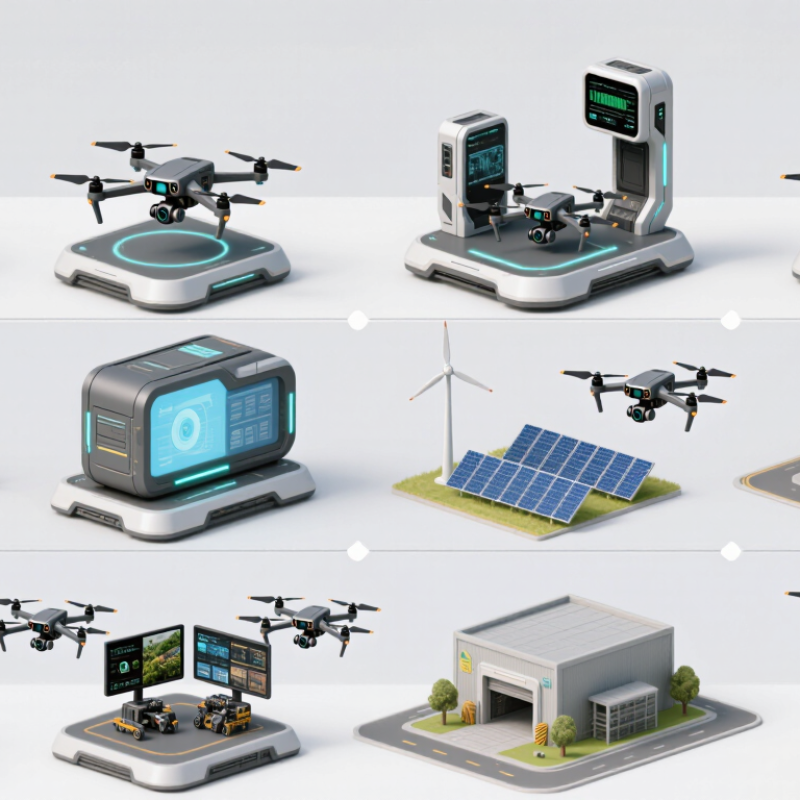
| 1 | Fixed Automated Docking Station | Permanent enclosure with a landing pad, charging interface, environmental sensors, communications equipment and a protective cover. | Routine inspection, security patrols, infrastructure monitoring and scheduled data collection. | Continuous mains power; backup batteries are commonly used for safe shutdown and communications continuity. | High; supports automated landing, charging, health checks, mission upload and remote operation. | Usually designed for outdoor exposure, with drainage, ventilation, temperature control and dust protection. | Industrial sites, utilities, ports, campuses and remote monitoring locations. | Enables repeatable missions with limited on-site staffing and rapid redeployment between flights. | Requires civil works, reliable communications and compatibility between the aircraft and station. |
| 2 | Portable Field Ground Station | Transportable control console with antennas, mission-planning software, displays, batteries and equipment cases. | Surveying, emergency response, mapping, public safety and temporary operations. | Rechargeable battery packs, vehicle power or a portable generator. | Medium to high; flight automation depends mainly on the UAV and mission-control software. | Equipment cases may provide dust and splash resistance, but operators generally need additional shelter. | Construction sites, disaster zones, agricultural fields and temporary survey areas. | Fast to deploy, flexible and suitable for locations without permanent infrastructure. | Requires trained operators and regular battery, antenna and communications management. |
| 3 | Vehicle-Mounted UAV Station | Roof-, bed- or trailer-mounted launch and recovery equipment combined with onboard storage and charging systems. | Wide-area inspection, disaster assessment, border observation and mobile public-safety missions. | Vehicle electrical system with auxiliary batteries or an inverter; some systems use a generator. | Medium to high; can support automated launch and recovery when the vehicle is stationary. | Protected during transport; operational weather resistance depends on the platform and vehicle design. | Road networks, large properties, emergency deployments and remote field operations. | Combines mobility, equipment storage and a ready-to-use operating base. | Vehicle movement, vibration, space constraints and local airspace conditions can affect operations. |
| 4 | Rooftop UAV Station | Landing and charging unit installed on a building roof, usually connected to a control room or network operations center. | Urban inspection, traffic observation, roof and facade surveys, security and environmental monitoring. | Building mains power, often with an uninterruptible power supply for critical equipment. | High when integrated with automated mission scheduling and remote fleet management. | Requires structural anchoring, lightning protection, drainage and protection from wind and precipitation. | Commercial buildings, hospitals, campuses, warehouses and municipal facilities. | Provides elevated line of sight and can reduce the travel distance to nearby inspection areas. | Building permissions, rooftop access, wind exposure and urban flight restrictions must be addressed. |
| 5 | Solar-Powered Remote Station | Outdoor docking or communications enclosure with photovoltaic panels, charge controller, batteries and optional satellite or cellular links. | Environmental observation, agricultural monitoring, wildlife surveys and remote asset inspection. | Solar generation with battery storage; power availability varies with season, shading and mission load. | High for scheduled missions, system diagnostics and remote station monitoring. | Designed for long-term outdoor use with corrosion, water, dust and temperature protection. | Rural areas, forests, coastlines, pipelines and locations without grid electricity. | Can operate far from utility infrastructure with low routine energy requirements. | Cloud cover, snow, extreme temperatures and limited communications may reduce availability. |
| 6 | Containerized UAV Operations Station | Modified shipping or equipment container containing control consoles, battery systems, storage, communications and maintenance space. | Large-scale surveying, mining, infrastructure projects, defense support and extended field operations. | Grid connection, generator, solar system or a hybrid power architecture. | Medium to high; supports multiple operators and may coordinate several UAVs. | Strong structural protection and climate control when properly modified and maintained. | Mining areas, construction projects, temporary bases and remote industrial sites. | Offers secure workspace, equipment storage, environmental control and scalable operations. | Transport, installation, site preparation and logistics can be costly and time-consuming. |
| 7 | Tethered UAV Ground Station | Ground power and control unit connected to an aircraft by a physical tether carrying power, data or both. | Persistent observation, event security, communications relay and temporary lighting or imaging. | Continuous ground power supplied through the tether; onboard battery may provide emergency descent capability. | Medium to high; the tether manages endurance while the aircraft performs controlled flight. | Ground equipment can be ruggedized, but wind, rain and icing still affect aircraft operation. | Emergency scenes, public events, temporary security zones and communications support sites. | Supports flight durations far beyond those of battery-only aircraft while maintaining a fixed operating area. | Limited horizontal range, tether hazards, restricted maneuverability and dependence on ground power. |
| 8 | In-Vehicle Portable Dock | Compact docking, charging and storage module carried inside a van, utility vehicle or field equipment trailer. | Mobile inspection teams, utility maintenance, emergency response and repeated short-distance missions. | Vehicle alternator, auxiliary battery, shore power or portable generator. | Medium; provides organized charging and rapid launch preparation, while an operator commonly manages missions. | Protected while stored; the aircraft is exposed to outdoor conditions during launch, flight and recovery. | Mobile teams working across multiple sites during the same shift. | More compact and less expensive to install than a permanent automated dock. | Requires the vehicle to remain nearby and may offer limited protection against severe weather. |
| 9 | Maritime UAV Station | Marine-grade launch, recovery, charging and control equipment installed on a vessel, offshore platform or coastal facility. | Coastal surveillance, offshore inspection, search and rescue, fisheries monitoring and maritime mapping. | Vessel or platform power system with protected battery backup and marine-rated distribution equipment. | Medium to high; automated recovery is possible but requires accurate positioning and sea-state monitoring. | Corrosion-resistant construction, sealed electronics and protection from spray, salt and vibration are essential. | Ships, offshore platforms, ports, islands and coastal monitoring sites. | Extends observation and inspection capability beyond the immediate operating platform. | Saltwater corrosion, deck movement, strong winds, waves and difficult recovery conditions increase complexity. |
| 10 | Networked Remote Operations Station | Distributed control and data-management system connecting one or more launch sites to a remote operations center. | Fleet supervision, multi-site asset inspection, large-area mapping and centralized mission management. | Each local site normally requires its own power source; the operations center uses protected utility power and backup systems. | High; supports remote scheduling, telemetry, video, maintenance alerts and centralized reporting. | Protection varies by local station, while the control center is usually installed in a secure indoor environment. | Utilities, transportation networks, agriculture and geographically distributed assets. | Improves operational consistency and allows a small team to supervise multiple locations. | Dependent on reliable network coverage, cybersecurity, regulatory approval and system interoperability. |