
-
- Products
- Indoor Household Cords
- Appliance Cords
- General Purpose Short-Length Cords
- General Purpose Extension Cords
- Landscape & Decorating Cords
- Bright Color Extension Cords
- Oil-Resistant Extension Cords
- Cold-Flex Extension Cords
- VividFlex Power Cords
- EXTREME All-Weather Cords
- Cord Management
- Task Lights
- Adapters & GFCI Devices
- Where to Buy
- About
- Careers
- Glossary
- Catalog


How to Choose the Right Industrial Touchscreen?
Choosing the right Industrial Touchscreen is rarely a simple matter of selecting the largest display or the lowest price. In a factory, the screen may face dust, oil mist, vibration, gloves, and sudden temperature changes. A model that performs well in an office can fail beside a cutting machine. That difference matters.
Begin with the working environment. Check the required IP rating, operating temperature, brightness, and viewing angle. A food-processing line may need a sealed front surface for frequent cleaning. A warehouse terminal may require strong backlighting for sunlight near loading doors. Capacitive touch technology feels smooth, but thick gloves or moisture can reduce accuracy. Resistive touch may respond better in those conditions, although it can feel less modern.
The best decision also depends on integration. Confirm the operating system, mounting method, screen size, communication ports, and expected service life. Industrial users should request test reports, warranty terms, and evidence of long-term component availability. Standards and supplier documentation provide useful guidance, but real testing remains essential. Ask the vendor to demonstrate the panel with your gloves, software, cables, and cleaning process. Small details often expose major weaknesses.
There is no universal winner. Sometimes, I have seen teams overvalue resolution while overlooking connector protection. That mistake becomes expensive later. A reliable Industrial Touchscreen should support safe operation, clear visibility, stable communication, and practical maintenance. Choose for the actual workspace, not for a product photograph. Even experienced buyers should leave room for doubt, because field conditions are often less predictable than specifications suggest.
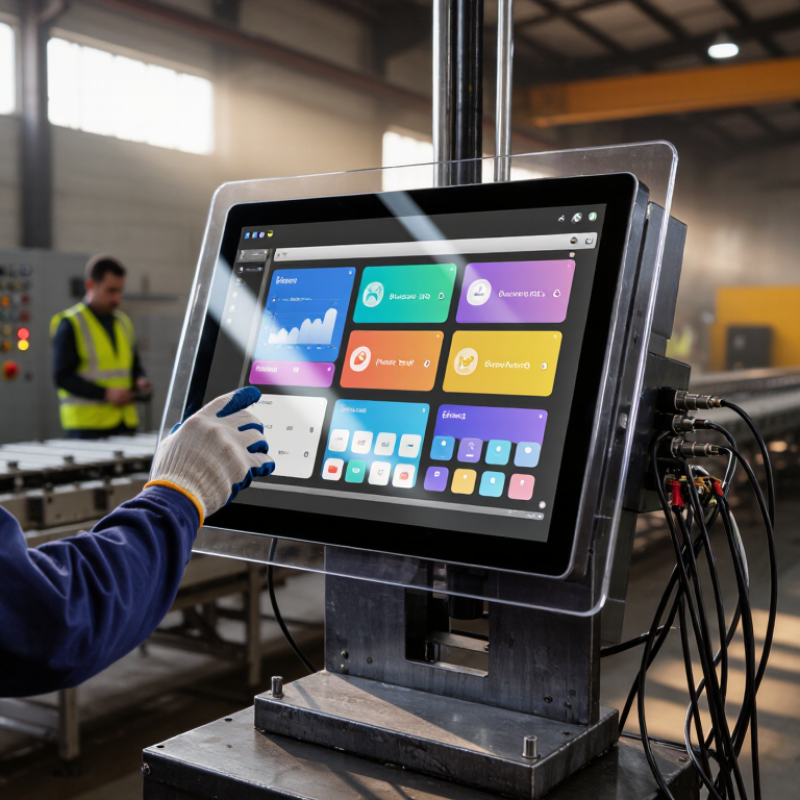
Table of Contents [Hide]
Define the Industrial Environment and Operating Conditions
How to Choose the Right Industrial Touchscreen?
Choosing an industrial touchscreen begins with the environment, not the screen size. Map temperature, humidity, dust, water, vibration, and lighting around the installation point. A production line may experience heat from ovens, sudden cooling during washdowns, and constant mechanical movement. Near cutting equipment, airborne particles can settle around connectors and ventilation openings. Record the highest and lowest conditions, including seasonal changes. Small details matter.
Operating conditions also determine the touchscreen’s practical design. Workers may use gloves, wet fingers, or tools while wearing protective equipment. Test touch accuracy with the actual gloves used on site. Strong sunlight can reduce readability, while dim areas require controlled brightness without causing glare. Cleaning chemicals may damage unsuitable surfaces. An enclosure rating should match the expected exposure, and cable protection must suit vibration and repeated movement. Do not rely on a dry laboratory test alone.
Define required uptime, response speed, mounting space, and service access before selecting hardware. Check whether operators need alarms, large controls, or readable data from several meters away. Field testing should include temperature changes, vibration, moisture, and repeated touches. A paper specification can still disappoint. That assumption is convenient, but incomplete. It is also wise to question early estimates, because real operators often work faster and less carefully than planned. Leave room for maintenance, gloves, fingerprints, and imperfect cleaning routines.