
-
- Products
- Indoor Household Cords
- Appliance Cords
- General Purpose Short-Length Cords
- General Purpose Extension Cords
- Landscape & Decorating Cords
- Bright Color Extension Cords
- Oil-Resistant Extension Cords
- Cold-Flex Extension Cords
- VividFlex Power Cords
- EXTREME All-Weather Cords
- Cord Management
- Task Lights
- Adapters & GFCI Devices
- Where to Buy
- About
- Careers
- Glossary
- Catalog


How to Source Marble Slab Globally in 2026?
How to Source Marble Slab Globally in 2026? The question is larger than finding the lowest quotation. It involves geology, processing capacity, export records, container planning, and quality control. Marble Slab may begin as a block in Carrara, Antalya, or Gujarat, then change hands across several markets. Every transfer adds risk.
Trade data offers a useful starting point. The International Trade Centre’s Trade Map records worked marble under HS 6802 categories, helping buyers compare exporting countries and market trends. However, these codes can combine slabs, tiles, and other worked stone. The numbers are helpful, but not perfectly precise. The U.S. Geological Survey’s Mineral Commodity Summaries also shows why dimension-stone data requires caution: production reporting is uneven across countries. A neat spreadsheet can still lie.
Reliable sourcing therefore needs evidence beyond a catalog image. Request the quarry name, block number, slab dimensions, resin treatment, finish, and recent inspection records. Ask for water absorption, flexural strength, and staining information where applicable. The Natural Stone Institute emphasizes documentation, fabrication guidance, and material performance in professional stone projects. These references support a more disciplined buying process.
Inspect the actual bundle whenever possible. Look for matching veining, chipped edges, resin repairs, and moisture marks. Photograph each slab before loading. Confirm packaging, fumigation requirements, insurance, and Incoterms in writing. Ocean freight may appear inexpensive until breakage, port storage, or customs delays occur. Use independent inspection for valuable orders. Not every famous quarry is consistent. Not every low-price supplier is unreliable. Global Marble Slab sourcing works best when data, samples, and human judgment meet.
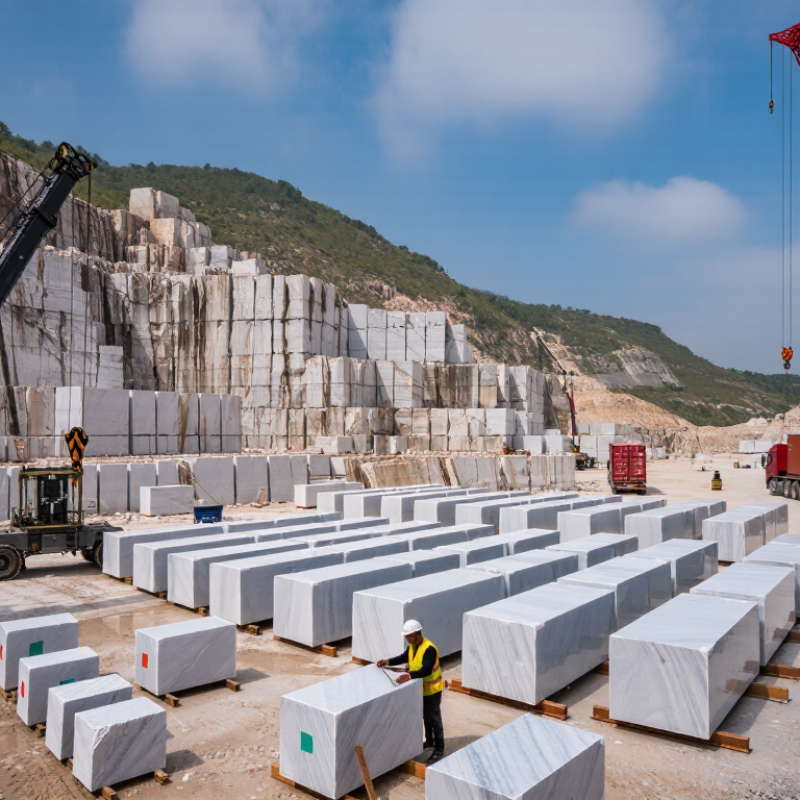
Table of Contents [Hide]
Define Marble Slab Requirements, Quality Standards, and Project Scope
Global marble sourcing should begin with a measurable project brief, not attractive photographs. Define slab length, width, thickness, finish, color range, veining direction, and acceptable repair levels. State the application clearly: kitchen worktops, hotel walls, flooring, or ventilated façades require different performance criteria.
Grand View Research estimated the global marble market at about USD 18.7 billion in 2023, with continued growth expected through 2030. That scale increases supplier choice, but it also increases specification risk. Require quarry origin, block or lot numbers, and recent inspection records. Test water absorption, flexural strength, and abrasion resistance against the project’s exposure. ASTM C503/C503M covers marble dimension stone, while ASTM C880/C880M addresses flexural strength. For external cladding, EN 1469 provides relevant product guidance.
Project scope should include usable yield, matching rules, edge profiles, packing, moisture protection, and replacement procedures. Request full-size samples. Small samples hide natural movement. I have seen approved colors change significantly between lots. A realistic tolerance for shade variation is essential. Perfect uniformity is rarely achievable in natural stone.
The U.S. Geological Survey’s 2025 Mineral Commodity Summaries also highlights incomplete country-level reporting for dimension stone. Verify supplier data independently. Ask for quarry capacity, inspection photos, test dates, and container-loading records. One weakness remains: laboratory results may not represent every slab. Reserve approval rights after arrival, and budget for sorting, cutting loss, and occasional rejection.