-
- Products
- Indoor Household Cords
- Appliance Cords
- General Purpose Short-Length Cords
- General Purpose Extension Cords
- Landscape & Decorating Cords
- Bright Color Extension Cords
- Oil-Resistant Extension Cords
- Cold-Flex Extension Cords
- VividFlex Power Cords
- EXTREME All-Weather Cords
- Cord Management
- Task Lights
- Adapters & GFCI Devices
- Where to Buy
- About
- Careers
- Glossary
- Catalog

How to Choose Flame Retardant Cable in 2026?
Choosing a Flame Retardant Cable in 2026 requires more than comparing prices, colors, or catalogue claims. The decision affects evacuation routes, data centers, hospitals, tunnels, and industrial facilities. According to the National Fire Protection Association’s Fire Loss in the United States During 2023 report, U.S. fire departments responded to approximately 1.5 million fires. These incidents caused 3,670 civilian deaths, 13,250 injuries, and about $22.4 billion in property damage. Cables cannot prevent every fire. They can, however, influence flame spread, smoke production, and circuit survival.
Performance must be verified against the installation’s real hazards. IEC 60332-1-2 evaluates vertical flame propagation on a single insulated wire or cable. IEC 60754 addresses halogen acid gas emissions, while IEC 61034 measures smoke density. A Flame Retardant Cable may pass one test and still perform poorly in another. That detail is often missed. The label alone is not enough.
Fire researcher Richard G. Gann has observed, “Fire is a complex phenomenon, and no single measurement can describe it.” His warning applies directly to cable selection. A responsible specification should examine conductor size, insulation material, fire rating, smoke behavior, toxicity, bending conditions, installation density, and third-party certification. It should also consider maintenance records and actual fault scenarios. A cable installed beside tightly packed trays faces a different challenge from one placed in open air. Perfect choices do not exist. Better decisions come from evidence, transparent testing, and honest recognition of uncertainty. This guide explains how to compare Flame Retardant Cable options in 2026 without trusting marketing language alone.
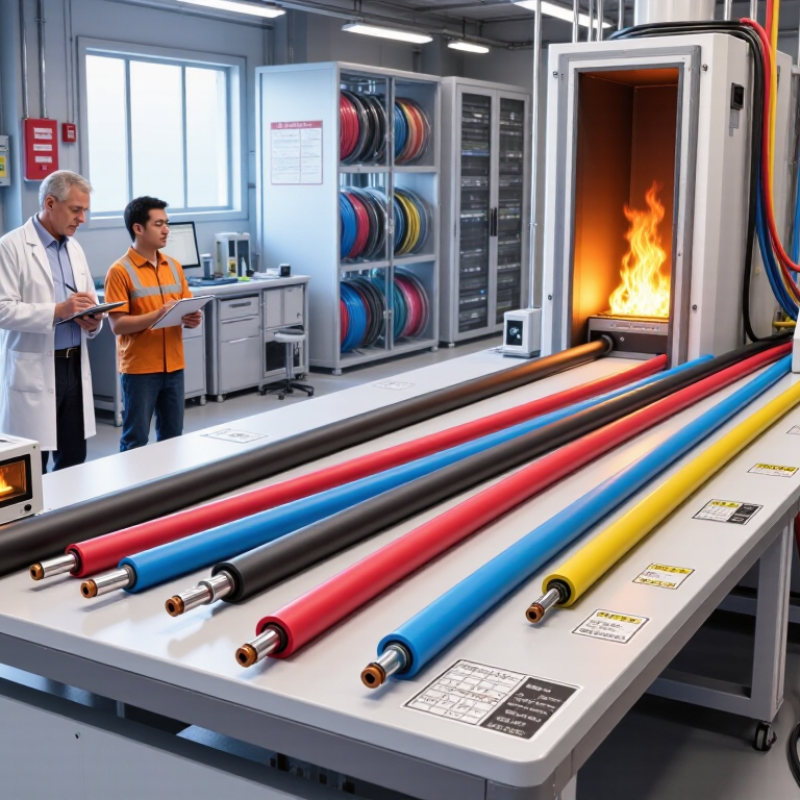
Table of Contents [Hide]
Understanding Flame Retardant Cable Ratings and Standards
How to Choose Flame Retardant Cable in 2026?
Understanding Flame Retardant Cable Ratings and Standards
Choosing a flame retardant cable starts with its test rating, not its marketing description. IEC 60332-1-2 evaluates flame spread on a single vertical cable. IEC 60332-3 examines grouped cables, where fire can travel upward between several installed lines. These tests are different. A cable passing one test may not pass the other.
Check the required standard for your project location. European installations may use EN 60332 and CPR classification under EN 50575. CPR classes range from Aca to Fca, with smoke and flaming-droplet ratings added separately. In North American projects, VW-1 testing is common, but it does not replace every system requirement. Always read the full test report.
Smoke matters too. IEC 61034 measures smoke density, while IEC 60754 evaluates corrosive gases released during burning. Low-smoke does not automatically mean low toxicity or zero halogens. The wording can mislead. A practical inspection should compare conductor size, insulation material, voltage rating, bend radius, and installation grouping. I once treated flame resistance as the main selection factor; that checklist was too simple. Cable spacing and tray design can change real fire behavior. Verify the certificate, test method, cable construction, and local electrical rules before ordering.