
-
- Products
- Indoor Household Cords
- Appliance Cords
- General Purpose Short-Length Cords
- General Purpose Extension Cords
- Landscape & Decorating Cords
- Bright Color Extension Cords
- Oil-Resistant Extension Cords
- Cold-Flex Extension Cords
- VividFlex Power Cords
- EXTREME All-Weather Cords
- Cord Management
- Task Lights
- Adapters & GFCI Devices
- Where to Buy
- About
- Careers
- Glossary
- Catalog


What Are the Best Safety Lockout Padlocks in 2026?
Choosing the best Safety Lockout Padlocks in 2026 is not about finding the brightest color or lowest price. It is about matching a lock to the equipment, work environment, and people who will use it. A padlock on a damp outdoor disconnect faces different demands from one used on a clean indoor control panel. Small details matter: shackle clearance, key control, body material, and whether gloves make operation awkward. The wrong fit can turn a simple isolation step into a frustrating one.
Industrial safety consultant Jordan Lee offers a practical reminder: “A lockout padlock is only effective when it fits the isolation point and the worker’s routine.” Treat that as a buying principle, not a substitute for your site’s procedures. In this guide, we compare common features, including nonconductive bodies, corrosion resistance, keyed-different options, and clear identification. We also consider durability and ease of inspection. Some specifications look impressive on a product page but reveal little about performance in daily use. That deserves a closer look.
There is no universal winner. A compact lock may suit a crowded panel, while a longer shackle may be needed for a particular hasp. Check compatibility before ordering. Confirm that labels remain readable after handling, and test the lock with the gloves your team actually wears. Simple, but often missed. The recommendations ahead are intended to help safety managers and maintenance teams compare options with care. Product details can change, so verify current specifications with the manufacturer before purchase.
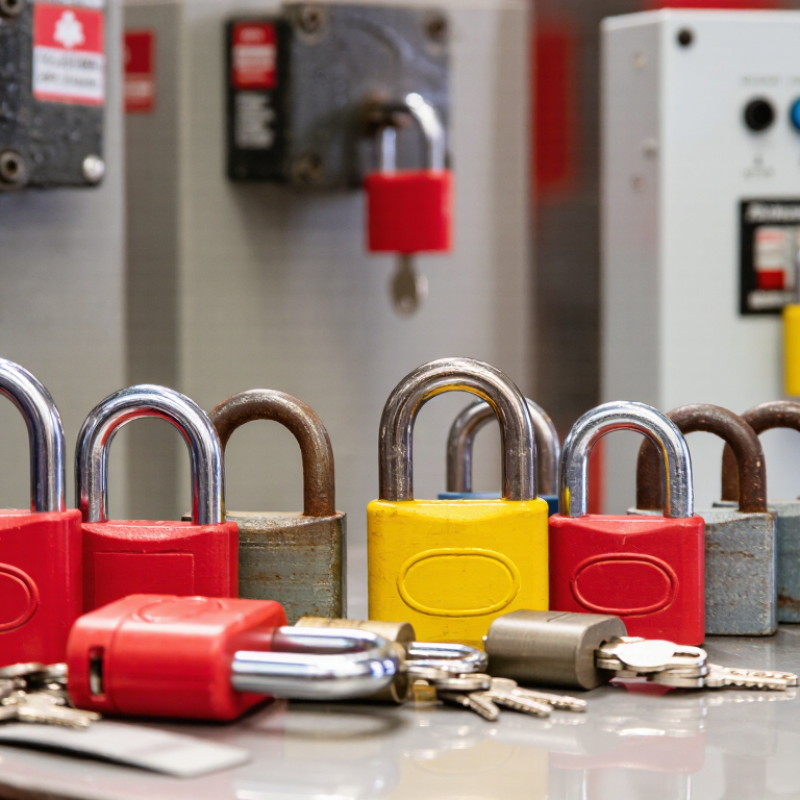
Table of Contents [Hide]
What Safety Lockout Padlocks Do and Where They Are Used
Safety lockout padlocks isolate hazardous energy during servicing. A worker attaches one to an energy-isolating device, such as a disconnect switch, valve, or circuit breaker. The lock prevents accidental re-energization while maintenance continues. OSHA’s Control of Hazardous Energy standard, 29 CFR 1910.147, requires documented procedures, employee training, and verification before work begins. OSHA estimates that effective lockout/tagout practices prevent about 120 fatalities and 50,000 injuries each year in the United States.
These padlocks are used in factories, warehouses, utilities, construction areas, and commercial facilities. Common hazards include electrical current, hydraulic pressure, compressed air, steam, gravity, and stored mechanical energy. A suitable 2026 padlock should resist corrosion, remain clearly identifiable, and fit the site’s lockout devices.
Color coding can show department ownership, but color alone is not enough. Each authorized worker should control a uniquely keyed lock. Group maintenance may require a lock box or multi-lock hasp. From field experience, the weakest point is often poor verification, not the lock itself. A locked switch can still hide pressure or movement.
Tips: Choose a nonconductive body near electrical equipment. Keep duplicate keys controlled. Test the isolation before touching the machine. Train contractors separately. Inspect damaged locks immediately. OSHA emphasizes periodic inspections, yet teams sometimes treat them as paperwork. That is a mistake worth correcting.