
-
- Products
- Indoor Household Cords
- Appliance Cords
- General Purpose Short-Length Cords
- General Purpose Extension Cords
- Landscape & Decorating Cords
- Bright Color Extension Cords
- Oil-Resistant Extension Cords
- Cold-Flex Extension Cords
- VividFlex Power Cords
- EXTREME All-Weather Cords
- Cord Management
- Task Lights
- Adapters & GFCI Devices
- Where to Buy
- About
- Careers
- Glossary
- Catalog


Why Choose a Copper Busbar Extrusion Machine?
Why choose a Copper Busbar Extrusion Machine? The answer begins with rising demand for reliable electrical conductors. The International Energy Agency’s Global EV Outlook 2024 reported more than 14 million electric car sales in 2023. It also projected sales above 17 million in 2024. Renewable infrastructure is expanding too. IRENA’s Renewable Capacity Statistics 2024 recorded 473 gigawatts of new renewable capacity installed worldwide during 2023. These systems need compact, low-resistance conductors. Copper busbars often connect switchgear, inverters, transformers, batteries, and industrial distribution panels.
A Copper Busbar Extrusion Machine can produce continuous profiles with controlled dimensions and stable surface quality. Continuous extrusion may reduce handling steps, material waste, and joint-related inconsistencies. It can also support repeatable production of complex cross-sections. That matters when a busbar must fit a narrow cabinet channel or maintain a precise contact area. Less scrap helps. Better consistency helps more.
However, the machine is not a complete solution. Die design, copper cleanliness, temperature control, cooling speed, and inline measurement directly affect performance. A poorly specified line can create distortion, uneven conductivity, or costly rework. Engineers should compare output rate, maximum profile size, automation features, energy consumption, maintenance access, and testing capability. Independent industry data supports the market need, but factory results still require verification. Pilot trials, dimensional records, and electrical-resistance testing provide stronger evidence than brochures alone. The right decision depends on product mix, not fashion. That detail is easy to overlook.
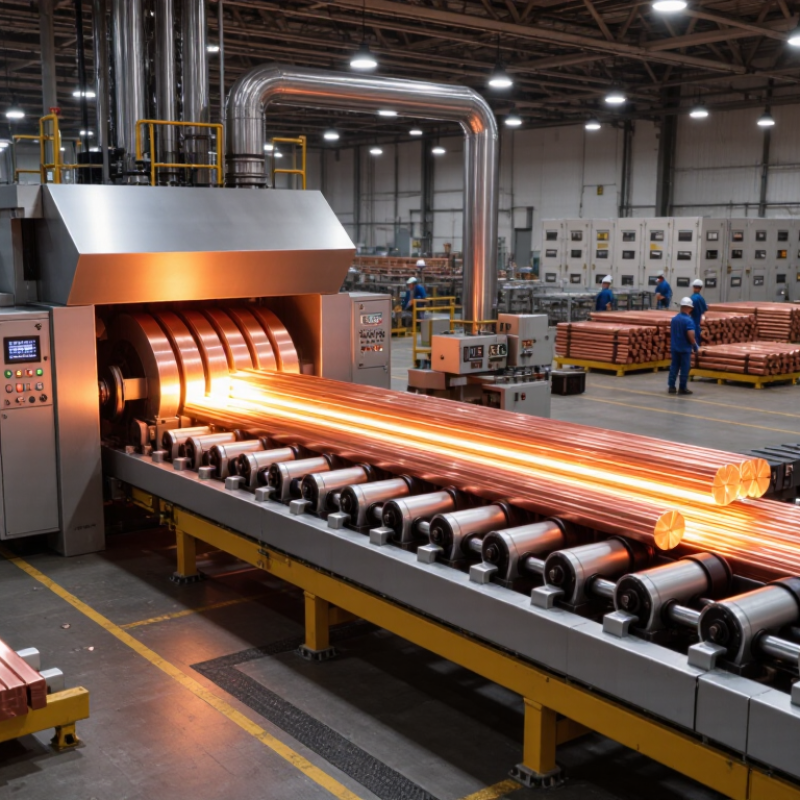
Table of Contents [Hide]
Copper’s 100% IACS Conductivity and Its Busbar Performance
Why Choose a Copper Busbar Extrusion Machine?
Copper’s 100% IACS Conductivity and Its Busbar Performance
Copper’s 100% IACS rating is a reference point, not a vague sales claim. The International Annealed Copper Standard defines this value at about 58 MS/m and 20°C. Its reference resistivity is approximately 0.01724 Ω·mm²/m. For busbars, that low resistance reduces I²R losses during continuous current flow. It also limits unnecessary heat inside switchboards and power distribution equipment.
The International Copper Association reports that copper maintains strong electrical performance while offering excellent thermal conductivity and mechanical reliability. In a real panel, a properly extruded busbar can carry current through clean edges and stable dimensions. A smooth 10 mm contact face matters when bolted joints must remain flat. Small defects can increase local heating. They are easy to underestimate.
An extrusion machine supports repeatable width, thickness, length, and surface quality. Controlled die pressure and cooling help reduce warping after the hot profile exits the die. IEC 61439 requires verification of assemblies, including temperature-rise performance, so dimensional consistency supports safer engineering decisions. Still, 100% IACS does not guarantee perfect performance. Alloy content, joint pressure, oxidation, and operating temperature can change results. This is where production experience matters. A better machine cannot correct poor material selection or careless inspection.