
-
- Products
- Indoor Household Cords
- Appliance Cords
- General Purpose Short-Length Cords
- General Purpose Extension Cords
- Landscape & Decorating Cords
- Bright Color Extension Cords
- Oil-Resistant Extension Cords
- Cold-Flex Extension Cords
- VividFlex Power Cords
- EXTREME All-Weather Cords
- Cord Management
- Task Lights
- Adapters & GFCI Devices
- Where to Buy
- About
- Careers
- Glossary
- Catalog


2026 Top Portable Gas Detectors Which One Is Best?
Choosing the best Portable Gas Detector is not a spec-sheet exercise. It is a decision about whether a worker can trust an alarm in a noisy plant, a dim utility vault, or a poorly ventilated work area. The International Labour Organization’s 2023 report estimates nearly three million work-related deaths worldwide each year. NIOSH’s confined-space guidance also warns that would-be rescuers have accounted for a large share of confined-space fatalities. These figures make clear why dependable detection, correct sensor selection, and routine checks matter.
NIOSH Director Dr. John Howard has consistently emphasized prevention in occupational safety. Put into practical terms, that means identifying atmospheric hazards before workers are exposed—not relying on an instrument after conditions become dangerous. This is a paraphrase of his prevention-focused message, not a verbatim quotation. A detector can support that goal, but it cannot replace training, maintenance, or a clear response plan.
This 2026 guide compares leading portable models by sensor coverage, alarm design, durability, battery life, calibration needs, and ease of use. A bright screen helps in low light. A loud, distinct alarm matters beside running machinery. And a device that is awkward to clip onto a belt may stay in a case when it is needed most. No single model fits every task. Even careful comparisons have limits: performance depends on the gases present, the environment, and upkeep. The right choice is the one workers can use correctly, every shift.
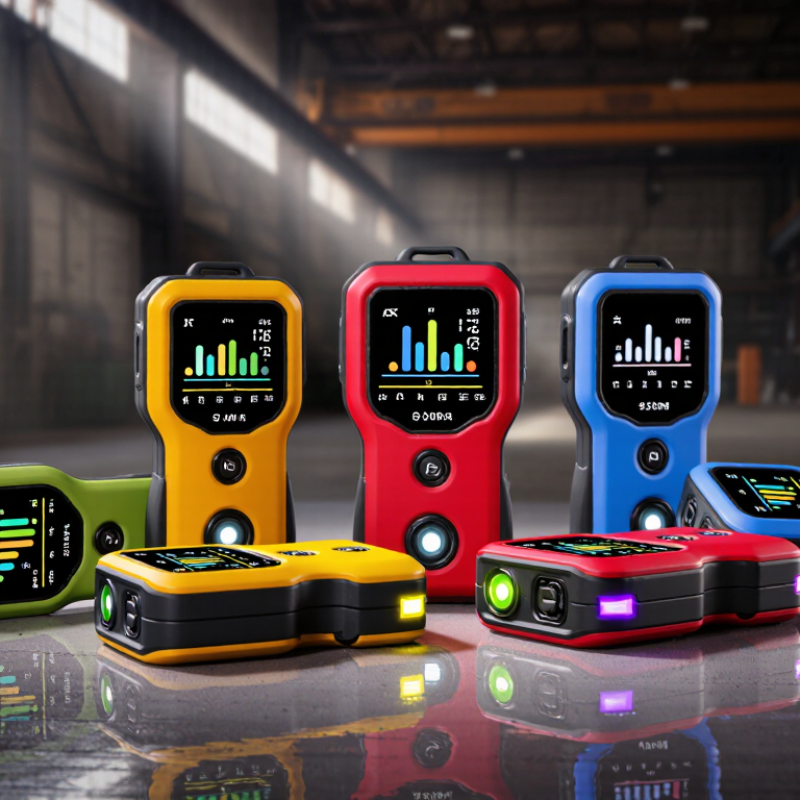
Table of Contents [Hide]
How Portable Gas Detectors Detect Hazardous Gases
2026 Top Portable Gas Detectors Which One Is Best?
How Portable Gas Detectors Detect Hazardous Gases
Portable gas detectors measure gases in the air around a worker. Diffusion models rely on air reaching their sensors; pumped models draw samples through a probe or tube. Different sensors respond to different hazards. Electrochemical cells commonly measure toxic gases, catalytic sensors detect combustible gases, and infrared sensors identify some gases by how they absorb light. No single sensor detects everything. OSHA’s confined-space guidance recommends testing oxygen first, then combustible gases, and then toxic contaminants.
Numbers need context. The NIOSH Pocket Guide lists hydrogen sulfide’s IDLH concentration as 100 ppm and carbon monoxide’s as 1,200 ppm. IDLH means immediately dangerous to life or health; it is not a recommended alarm setting. OSHA defines an oxygen-deficient atmosphere as below 19.5% oxygen. A detector’s reading can also be affected by calibration, sensor condition, temperature, and sampling time. A neat display can still mislead.
Before use, check the instrument and follow its calibration and function-test instructions. Sample different levels in a space when gases may collect unevenly, and allow time for readings to stabilize. Tubing can delay results. One stable reading is only a clue, not proof that an area is safe. Detector choice should match the gases expected, the work setting, and the limits of each sensor.