| Equipment and Performance Reference |
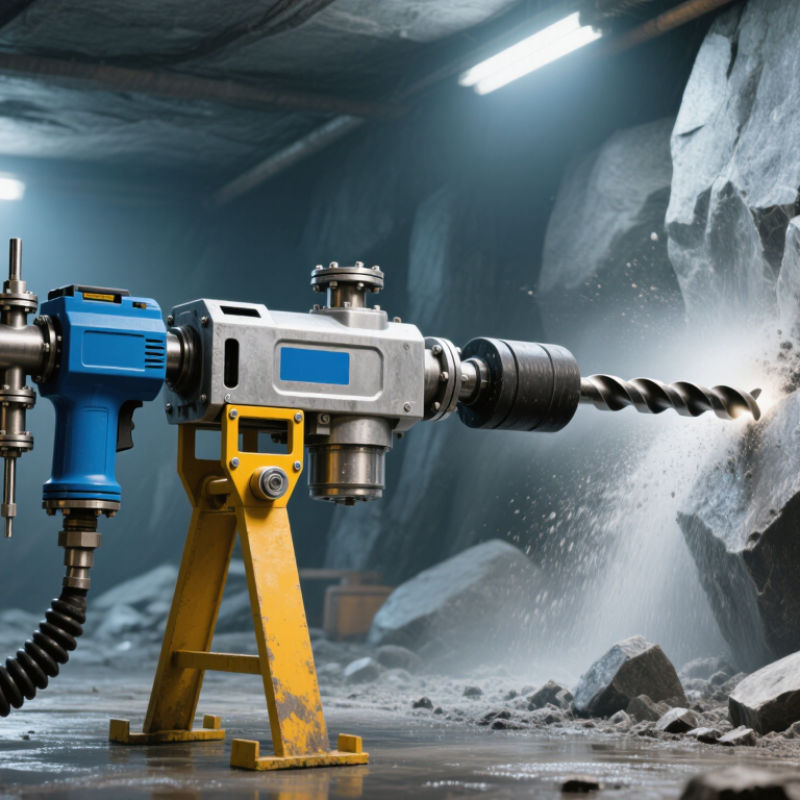
| Drill category | Hand-held pneumatic rock drill with air leg | Designed for underground development, drifting, quarrying, and small-to-medium blast-hole work where compressed air is available. |
| Nominal air pressure | 7 bar / 0.70 MPa / approximately 102 psi | Use a regulated supply close to the drill manufacturer’s specified operating pressure. Pressure must not exceed the lowest-rated component in the complete air system. |
| Typical air consumption | Approximately 60–75 L/s at rated pressure | Size the compressor, receiver, filters, valves, and hose for continuous demand. Actual consumption varies with drill condition, drilling resistance, pressure, and control-valve setting. |
| Typical impact frequency | Approximately 2,000–3,000 blows/min | Higher impact frequency does not automatically mean better drilling. Maintain sharp bits, correct feed force, and stable air pressure to control vibration and tool wear. |
| Typical drill-steel compatibility | Commonly 22 mm shank systems; verify the exact shank standard | The bit, shank, bushing, and chuck must be matched. Incorrect shank dimensions can cause poor energy transfer, premature wear, or ejection hazards. |
| Typical hole diameter range | Approximately 34–42 mm, depending on bit and rock conditions | Hole size depends on bit geometry, rock strength, fracture pattern, and the planned blasting method. Confirm the required diameter with the mine plan. |
| Typical stroke | Approximately 60 mm | A stroke near this range is common for S83-class pneumatic drills, but the actual value should be checked in the equipment manual before selecting drill steel. |
| Approximate drill mass | Approximately 23–27 kg for the drill body; air-leg mass is additional | Assess total handling weight, operator posture, mounting height, and lifting arrangements. Use mechanical assistance where manual handling creates an injury risk. |
| Rotation system | Pneumatic rotation; speed varies by design and load | Rotation must remain smooth without binding. Stop the drill before clearing a jam, changing steel, or placing hands near the chuck. |
| 7 bar Air-Line Design and Inspection |
| Supply-pressure control | Regulator set to the equipment specification; nominal reference: 7 bar | Install a pressure regulator and gauge at the working area. Do not compensate for undersized hoses by raising pressure above the approved limit. |
| Hose working-pressure rating | At least the maximum system pressure | Select air hose, couplings, valves, and whip-check devices with compatible pressure ratings. The assembly rating is limited by its lowest-rated part. |
| Hose sizing | Use the manufacturer’s airflow table; avoid unnecessarily long or narrow hose | Pressure drop increases with length, small internal diameter, restrictive couplings, bends, and clogged filters. Measure pressure at the drill, not only at the compressor. |
| Couplings and hose restraint | Positive-lock couplings with safety clips and whip checks | Secure connections against accidental separation. Never connect or disconnect a pressurized hose, and never carry a pneumatic drill by its hose. |
| Condensate management | Drain receivers, low points, filters, and separators routinely | Water in the air line can wash lubricant from the motor, promote corrosion, freeze in cold conditions, and reduce drilling performance. |
| Pre-start air-line inspection | Every shift and after relocation | Check hose cuts, bulges, abrasion, coupling damage, gauge function, regulator setting, valve operation, and visible leaks before energizing the drill. |
| Lubrication and Maintenance Controls |
| Air-line lubricator | Install an inline pneumatic oiler close to the drill where permitted | Use the lubricant specified for the drill and mine environment. A lubricator should be installed in the correct airflow direction and kept filled only when the line is isolated. |
| Lubrication quantity | Set according to the equipment manual; do not use a universal fixed dose | Too little oil accelerates vane, piston, and cylinder wear. Too much oil can contaminate the workplace, increase consumption, and create unnecessary slip or exposure hazards. |
| Manual oiling | Use only the approved procedure when an automatic oiler is unavailable | Isolate and depressurize the line before adding oil. Never pour oil into a live coupling or place fingers near an open air outlet. |
| Lubricant selection | Use pneumatic-tool oil compatible with seals and the mine’s environmental requirements | Do not substitute gasoline, diesel, brake fluid, or incompatible solvents. Store lubricant in labeled containers and manage spills promptly. |
| Maintenance interval | Daily inspection; scheduled service based on operating hours and condition | Inspect the chuck, bushing, shank, water ports, air leg, fasteners, and controls. Remove the drill from service if abnormal noise, excessive vibration, leakage, or reduced impact occurs. |
| Dust Control, Water, and Worker Protection |
| Preferred drilling method | Wet drilling with water injection | Water reduces airborne respirable dust at the bit. Confirm that the drill is designed for water flushing and that the water circuit is clean and correctly connected. |
| Water pressure | Maintain positive water pressure at the drill; follow the equipment manual | Water pressure should be sufficient to prevent dust blowback and clear cuttings without damaging seals or creating uncontrolled spray. Do not assume air pressure and water pressure are interchangeable. |
| Dry drilling | Use only where permitted and with engineered dust extraction or suppression | Dry drilling can generate respirable crystalline silica and other hazardous dust. Apply the mine’s dust-control plan and use suitable respiratory protection where required by risk assessment. |
| Ventilation | Maintain the approved mine ventilation quantity and direction | Ventilation must control dust, diesel pollutants, and exhaust air without directing contaminated air toward workers. Do not rely on ventilation alone to control drilling dust. |
| Respiratory protection | Use a fit-tested respirator when required by exposure assessment | Respirators supplement, but do not replace, wet drilling, local exhaust, enclosure, housekeeping, and exposure monitoring controls. |
| Noise and vibration | Use hearing protection and manage hand-arm vibration exposure | Record measured noise and vibration where required. Rotate tasks, maintain tools, keep a firm but non-excessive grip, and follow the site’s exposure limits and rest schedule. |
| Personal protective equipment | Helmet, eye protection, hearing protection, protective footwear, gloves, and task-appropriate respiratory protection | Gloves must not create an entanglement risk around rotating components. Keep clothing, hair, and loose items away from the chuck and air leg. |
| Selection Checklist for a 2026 Mining Purchase |
| Air-system compatibility | Pass / verify | Confirm the mine can deliver the required flow at approximately 7 bar at the drill, including simultaneous users and expected pressure losses. |
| Dust-control compatibility | Pass / verify | Confirm water-injection capability, water quality, flushing arrangement, drainage, and compatibility with the site dust-management plan. |
| Operator ergonomics | Pass / verify | Assess air-leg adjustment range, drilling height, total mass, control placement, vibration, noise, and access in the actual working envelope. |
| Compliance documentation | Required before deployment | Obtain the operating manual, maintenance schedule, pressure and flow data, hose/coupling requirements, risk assessment, inspection records, and applicable local mining approvals. |
| Emergency isolation | Required | Provide a clearly accessible shut-off valve, isolate and bleed the line before service, and apply the mine’s lockout/tagout procedure. |